Tuesday, 26 August 2014

Social Media for Social Good by Mr. Gopi Kallayil

Social Media for Social Good
    
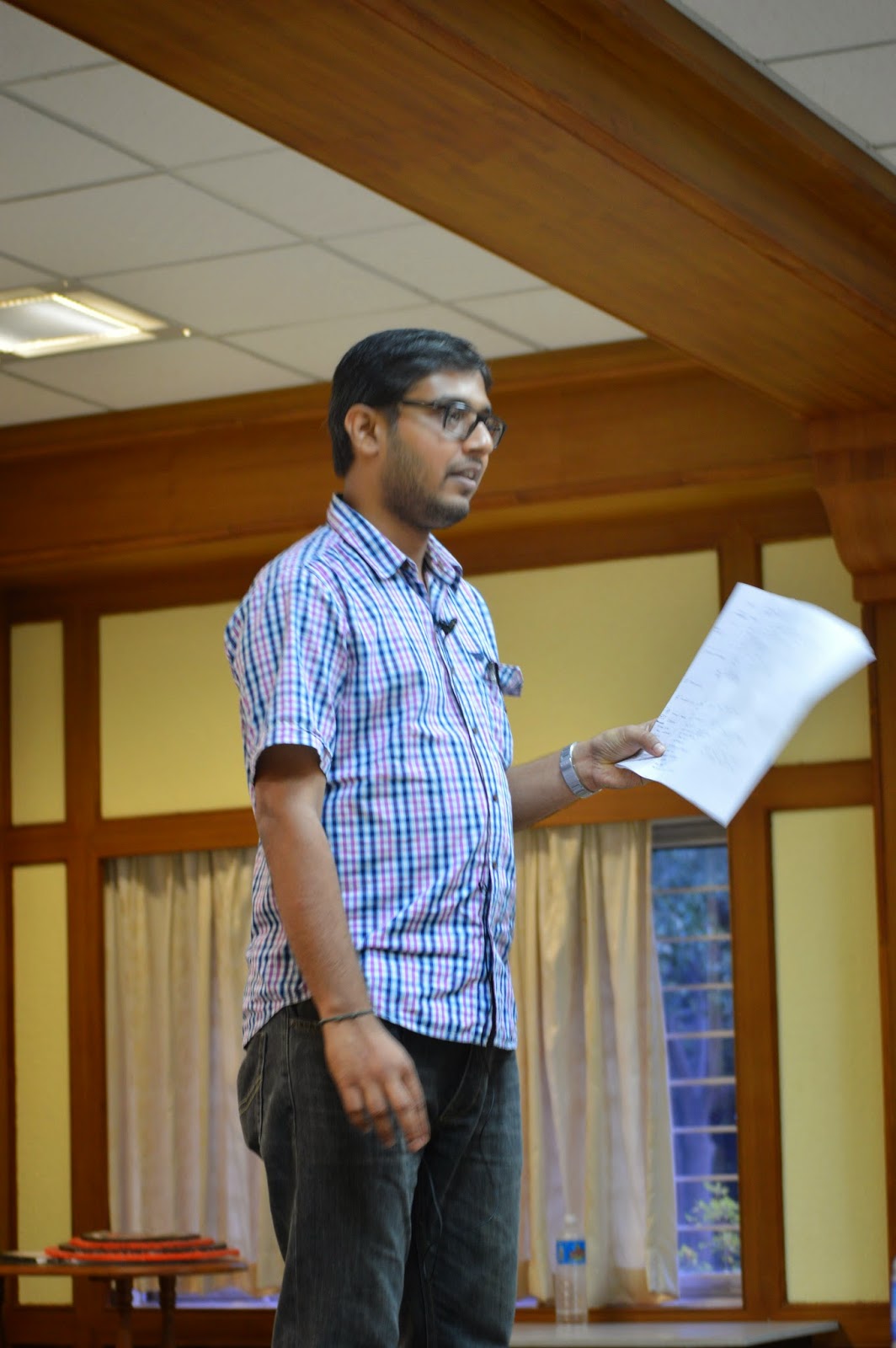
Mr. Gopi Kallayil, the Chief Evangelist at Google+ , was definitely the most popular colloquium speaker of the year. He is an award-winning Toastmaster and a TEDx Berkeley speaker, and so it was a not a surprise that his talk became quite popular. He opened the talk asking us all, “Do you know how many organs are there in the human body?”  Many guesses went up in the air. Then he said “When I asked my most trusted source of information - Miss Google… Miss Google told me there are 78. I wanted to add to it the 79th organ. “The smart phone!”  He pointed to the fact that 6 billion out of the 7 billion strong global population has access to some sort of a mobile device. And so his topic for the day was “Social Media for Social Good”.

Mr. Kallayil said he had a moment of epiphany about all this. He took us on his journey from the rice cultivating village of Chittilencheri in Kerala, India. While he was a small kid, the whole village had access to only two telephones and he was considered a child prodigy as he had the entire village’s contacts memorized. When he was recently visiting the same old village for a ceremony, he was delighted to see almost everyone with a mobile “organ” in their hands enjoying the benefits of the all-pervasive technology. He emphasized on the fact that, without any discrimination, a great amount of the population has access to this computing power. He then said, “The important question is – what kind of social good is coming out of this level of interconnectedness between billions of people?” To showcase that, he shared three stories with us.

The first one was the story of Zack Matere from Soy, Kenya. His potato plantations were repeatedly failing. He tried learning about the problem from books but could not get much. So to quote Matere’s own words: “I did the search!” He learnt from one among the search results that ants were the problem and suggested sprinkling wood ash over the plants. It solved his problem and he got excited about the technology of internet. He then made a wooden notice board for the community there as all did not know to use the internet. As he got news or relevant information on his searches, he posted them for the benefit of the community. Matere said, “When people have access to knowledge, they find solutions to problems.” Kallayil commented that Matere’s genius lied in connecting a 2 years old technology and a 2000 years old technology for the greater benefit.

The second story came out of Ontorio, Canada and Scotts Valley, California, USA. John Butterill and Corey Fisk from California suffers from multiple sclerosis and it had been 10 years since she walked. She has great interest in photography. John Butterill a professional photographer from Canada is an expert in doing Photo Walks, where he takes photography learners to scenic locations to shoot and discuss techniques. Butterhill hosted a Photo Walk hangout and Fisk said “For the first time I feel like I am not trapped in my body!” Photographers from all over the world soon joined this project and helped many other people similar to Fisk to embark on a virtual journey.

The third story connected Cape Town, South Africa and Dharamsala, India. When Kallayil was ideating on the Google+ rollout, he imagined a conversation between His Holiness Dalailama and His good friend Archbishop Desmond Tutu on peace and compassion. Kallayil said, “When you imagine these crazy things, somehow the universe mystically aligns itself to make it happen!” Four days after he wrote this idea on a piece of paper, a fellow colleague from Google South Africa, who Kallayil had never met called him about the forthcoming birthday celebrations of the Archbishop and the celebration plan to invite His Holiness Dalailama. There was some logistics problem and asked Google if there was some technology with which the situation could be helped. The technology was not rolled out by then but was arranged for in less than 3 days making the impossible possible. And now the Dalailama has more than 12 million online followers.


Kallayil concluded that what was profound across these stories was that the community becomes the platform and a fertile ground for human beings to thrive, survive and do social good. Kallayil kept the session very interesting and interactive. He magically kept remembering names and let us all guessing how he knew our names. He also gave us answers and spoke to us about Google Cars and Google Glass. He deeply appreciated our then theme for our business fest – “Business Beyond Profits”. He left us all to ponder about how we could leverage social media for the social good.


Thursday, 21 August 2014

Winning Minds by Mr. Madhav Priyan


SPEAKER- Mr Madhava Priyan
14Th August 2014
Venue- Sri Krishna Hall


The colloquium with Mr Madhava Priyan was a memorable one.  Being the National Manager- HR, OD and Corporate Strategy at Flyjac Logistics Private Limited, his experience in the field of Human Resource management is commendable. He is also a wildlife enthusiast and loves spending his holidays in tree houses and cottages in wildlife sanctuaries in India.

The session began with his inputs on the perceptions and behavior of people in an organization or otherwise. He spoke on the psychological setup of individuals which influenced their decision making. An employee who is happy and content with his job and atmosphere in the workplace is likely to be more productive than an employee who is unhappy. The boss plays an important role in motivating and keeping the employees in the right frame of mind. “An employee leaves his boss, not his job” he claims, while speaking on the role of a boss in influencing an employee’s mind set and job satisfaction.

“Is getting habituated to something good or bad” was the next topic he shared his views on. The 75 students seated in the hall shared their views on this question. Mr Madhava Priyan believes that getting habituated to the right lifestyle or behaviour is important in performing the various roles in life. It leads to the right approach and control of a situation. He elaborated on this by giving an example of a baby elephant being chained to a tree from a very young age. The baby elephant gets habituated to this treatment of having a leg chained all the time that, even after becoming a tusker, the elephant is in the mind-set that the chain cannot be broken and he has to remain where he is chained. Even human beings, like the elephant, can get habituated to a certain lifestyle which would help them work in a particular job environment.

The next part of the session was an activity. When he called one of the students to draw a cat on the board, for the first few seconds, nobody got up from their chair to perform the task. Finally, when one of the students got up to complete the task, he appreciated him for the initiative. The person who has the courage to initiate a certain task and carry it forward shows his self-belief and confidence.
The manner in which one has to present themselves for an interview was also discussed. Various aspects regarding body posture, confidence, speech, enthusiasm, eye contact etc. were discussed.

In the question and answer session, questions were raised regarding careers in HR and its significance.

Mr Madhava Priyan believes that anybody with a passion and interest for human resource management can effectively fit into the role of a HR professional regardless of his/her educational background in under graduation. A HR professional with knowledge in other fields like marketing, finance or operations would add value to a HR role in the organization in a significant way as they would have knowledge of most aspects in the organization.

“Understanding the organizational behavior and implementing the right strategies for its efficient running is the key for the success of a HR professional and also for attaining employee satisfaction”. The session ended with this positive message from him. 

Krishna Nandan
(Team Colloquia Member)


Entrepreneurship by Mr. Shaswata and Mr. Zubair


Date – 11/8/2014
Kraft Junction and Worklab – The story of two start ups
On 11th August 2014, an enriching colloquium session on Entrepreneurship was organised. It was presided over by our very own alumnus Mr. Shaswata Majumdar who is presently the CEO of his own establishment – ChomSha Group followed by a brief session on Worklab Group by its CEO and founder Mr. Zubair Ali.

Kraft Junction

The session kicked off with Mr. Majumdar saying that his session would be an interactive one and not a speech and also laid a ground rule that both he and Mr. Ali should be called by their first names and not Sir.
Mr. Majumdar started off by talking about the basic instinct that any budding entrepreneur must have which is the leap of faith. According to him “Taking a leap of faith is not about jumping off a cliff and building your wings on the way down. It’s about being smart and jumping with a parachute on.” The setting up of any business is purely based on taking logical decisions and understanding priorities.  The following are some of the important advices on which he laid emphasis on : 


1.    Don’t go with the herd. Go for a job that lightens you and each day of yours.

2.    If you are taking up any work, make sure that you are working for the final destination and not for the journey.

3.    Believe in yourself.

4.    Be brave to fight for your dream.

5.    You must never have any regrets. If you have done something good then it’s wonderful else it’s an experience.

6.    Never make a random decision. Make a firm one so that you don’t regret.

7.    Be the process rather than just being a part of it.

Mr. Majumdar mentioned that understanding one’s colleague is one of the most essential aspects of running a successful business. Many great businesses have faltered when people couldn’t get along very well.
He also said that importance must also be given to smaller things that matter in life such as a person’s hobbies.
Before handing over the session to Mr. Ali, Mr. Majumdar gave a brief talk about online piracy.

Worklab

Mr. Zubair Ali is the founder and CEO of Worklab Group, a company that aims to fight online piracy which is presently a menace for most of the industries.  He spoke in depth about how piracy has affected the careers of many artists and how it has led to the decline in the number of people willing to take up such creative professions. He asked the students to throw questions at him which he answered effectively. Mr. Ali also spoke about the reasons for his strong belief in anti-piracy and the hardships that he had to endure in setting up Worklab Group. He wound up by saying,”By downloading any material illegally, you are taking one person’s job by which one child might lose his dream of education”. 

The two speakers then had an effective and lengthy post colloquia interaction where they interacted with students clarifying all their doubts and instilling them with motivation.

S. Deepak
(Team Colloquia Member)

Why MBA? Are you a thinker or a doer? by Mr. M.K Chandrasekhar


The session with Mr. M.K Chandrasekhar was extremely lively and power packed. With an unmatched experience in the field of marketing and brand management, he took us to an altogether different level. He made us aware of the concepts underlying the basics of a management course. He started the session with a few simple questions “Who are you? “  And “Why MBA?” 
 He moved on to explain the various factors to be taken care of in an interview. An Interview is all about the tenacity and attitude one displays, and much less emphasis is given to the skills. He went on to ask about our aspirations in life and whether we were clear or confused about it. Most of us were in a confused state, but he said it’s alright to be confused as it’s a good sign and that’s the best way to be, for achieving something great in future.
He said, “Don’t learn to get a job, but digest what you learn and then move from learning for a job to learning the job”. Jobs are not to be taken for sustenance. They are to be understood and only when one learns about it, does it become a profession. He also said, “tell me, I’ll forget, teach me, I’ll remember, involve me and I’ll learn”. Learning is a continuous process, hence we should learn to grow. Growth should not happen materialistically, it should happen mentally. He explained how to think differently in each moment. Success and failure are both in our hands. The way one handles the situation makes all the difference.  It’s always better to have a “we will” attitude than an “I will” attitude.
 Mr.M.K Chandrasekar also showed a few advertisements which made its products to have a different outreach in the public. The way these advertisements promoted their brands and at the same time how they made an impact on the society as a whole was discussed. He explained the concepts of brand positioning and emphatic communication through them. He also gave a few anecdotes which taught us that not every time we will be treated in the best manner and we should learn to accept those with a positive smile always. 
Whenever we work for an organization we should sell ourselves first. He concluded the enthralling session by giving the example of a cobweb, and asked where each one of us would like ourselves to be positioned. At the end, he summarized it by saying “to be in the centre, be in the construction”. 

Ritika 
(Team Colloquia Member)

Friday, 8 August 2014

Career Options in Finance... by Mr. Sankar Rajan

The colloquium session by Mr. Sankar Rajan, Sr. Analyst of Deutsche Bank, an alumni of Amrita School of Business, kick started with an interesting question to the audience, " What are your major interests and where you wish to work?"

After getting a handful of replies, he started discussing about the various career options in finance. A few snippets from the talk are iterated below-

Classical Finance Banking is divided into two-
  • NBFC (Non Banking Financial Company)
  • Investment Banking

NBFC's major works include -
  • Credit Approval
  • Advisories Job
  • Treasury Management
  • Sales

The areas of interest for the investment bankers include -
  • Proprietary Trading
  • Merger and Acquisition Advisory
  • Structuring
  • Underwriting
The major works of corporate finance sector was also discussed and it included valuation of companies and corporate finance evaluation. He emphasized on the importance of working in this sector, even though the number of job openings in this sector is pretty low. Mr. Sankar Rajan, further spoke about a job portal named "IIMJOBS.COM", and also gave the students a live demo for searching jobs through it. He explained the details and talked about the importance of having analytical and programming skills, which are always an add-on for any financial job.

Mr. Sankar briefed the students on Excel & VBA and its importance in any financial task. Being a CFA holder, he was able to make all the finance specialists understand the openings it gave in the corporate finance . According to him, it was his sheer dedication and hard work that paved way for this.

The session ended with a short class on IR SWAPS. It was a very informative session, where the students got a certain understanding about the never ending opportunities in the field of finance and also the various tools that are required and used in the financial world . The session was concluded by him with an advice,    "go in the right direction and money will follow you".


Saturday, 2 August 2014

Management Consulting by Mr. Kalyanaraman

Mr. Kalyanaraman , Management Consultant

Mr. Kalyanaraman has 9 years of experience as a Management Consultant and is currently on his way to take up an assignment at the FIFA World Cup Business Process management team in Qatar, where he’d be planning on the infrastructure development and restructuring plans after the WC.
Here are the interesting snippets from the session.

So what really is management consulting?
“A management consultant is someone who looks at your watch and tells you the time.”
It is divided into two types, Strategic and Implementing. He also spoke about how the internal controls(set of procedures that are embedded in the process to ensure that nothing intercepts the process) form a part of consulting. Three major tasks of a consultant are
  1. ·        Developing Policies and Procedures-helping develop HR and finance policies. And preparing the Policy statement of a company.
  2. ·        Overseeing Internal Auditing-which forms a part of internal risk management.
  3. ·        Compensatory Bench-marking-Comparing one company with others to know where exactly the company stands in the market. Knowing when/how to increase/cut down salary all form a part of this process.

Major challenges that a consultant faces:
·        Managing people’s expectations.
·        Knowledge about MS Word, PowerPoint, Excel and also the basics of  logical programming.
·        Assisting corporate transformation. Helping the employees of the weaker company during mergers.
·        Back-up plans and exit strategies.
·        Coming up with IMPLEMENTABLE solutions.


 Some key points to take home from the session:
·        Preparing oneself for long work hours. (18-20 hours for almost 2 years).
·        Most people are from a diverse background, so managing people’s expectations is the key.
·        Find something good? Share it.
·        Technical knowledge and people skills/networking is the key.
·        Working with uncertainty is the rule of thumb for a consultant. Ground rules are nothing but common sense.
·        The importance of branding oneself.
·        As a consultant, one cannot take decisions on behalf of the management.

He closed the session with interesting titbits from his life, one where he had to be ethical and not give in to his boss’ request and one where he was terminated for a project and wasn't paid for it.
It was an informative session overall and he ended with the saying, “Once a consultant, always a consultant.”


Monday, 10 March 2014

Seasons Pilgrimage


Season’s Pilgrimage


“No matter how intense your struggle may be, someone is being inspired by your fight. Your story and your courage is equipping them to see life through a completely different lens.”
-UNKNOWN

Jan 29th, 2014 has been stored in every ASBian’s mind. All of us had the opportunity to witness the launch of a very heart rendering book “Season’s Pilgrimage” written by our alumnus, and an emerging writer Mr. Eshwar Anand. The book is a collection of poems. The book was launched by our very respected and loved Dr. Sanjay Bannerjee, who was extremely humbled to have got this opportunity.
The colloquium started with all of us observing a minute of silence in remembrance of all the people who lost their lives because of cancer, and also those who presently are affected by this deadly disease. Moreover, Mr. Eshwar Anand believed that silence helps all of us calm down regardless of all our worries.
Mr. Eshwar lost his mother due to cancer in 2012. He has seen and gone through all the pains that cancer afflicts on a person. It puts them down mentally, financially, physically and psychologically. Cancer is not a life sentence. It’s just a word. People die out of fear than the disease itself. He emphasized on the fact that there is an urgent need to spread awareness and educate people about this disease and suppress the fear in the patients. Keeping this in mind Mr. Eshwar has started a campaign which gives strength to many patients to fight this disease.
Further, he showed us a video which was a poem, “Let me kiss you”, he wrote in remembrance of his mother. It reiterated the various moments and phases when a patient knows that he has cancer, and what it feels then. He shared with us the last words said by his mother “Kalpagam”, the meaning of which he still doesn’t know. It was a much disoriented phase for both of them. She behaved like a baby.
Mr. Eshwar ended the talk by saying that it’s very important for us to understand that people undergoing the pain of cancer are still alive and aware of their surroundings. It is our responsibility to inspire them.

Sharon Raj
(Team Colloquia member)